Context Canvas
Inspect what Oblive knows, where it came from, and whether the evidence is healthy enough for operations.
Context is the inspectable business knowledge available to the organization operator and department profiles. Files and object storage own semantic content; PostgreSQL coordinates revisions and operational state.
Structured Context
Each organization and enabled department uses the same small, formal structure:
| File | Durable meaning |
|---|---|
facts.toml | Fixed facts and hard constraints |
preferences.toml | Human configuration, operating preferences, and integration meaning |
workflows.toml | Existing organization or department know-how: owners, triggers, steps, approvals, outcomes, and failure policy |
memory/lessons.md | Verified reusable learnings rather than human configuration |
Every integration record belongs in preferences.toml under its immutable generated connector key.
The organization entry records provider identity, permission mode, organization purpose, policy,
business functions, typical work, workflow references, and allowed departments. Department entries
with the same key explain what the integration means for that department. Credentials, connection
health, and provider resources remain operational state outside Context.
Ask Chat to create or edit a workflow in plain language. Organization-wide workflows route to Operator; a named department workflow routes to that department. Oblive stages the complete changed TOML document, verifies it, shows the diff in Inbox, and promotes it only after human approval.
Context Health
Context health summarizes whether required scopes exist, sources are readable, evidence is grounded, and critical gaps remain. Treat a healthy indicator as a validation result, not a guarantee that the business will never change.
The first report appears after the first successful review. Before then, this page shows the review’s status and links to its task. A review includes saved sources even when they have not yet been cited. Unprocessed or unreadable evidence appears as a limitation, so useful findings can still be published without pretending that all evidence is available.
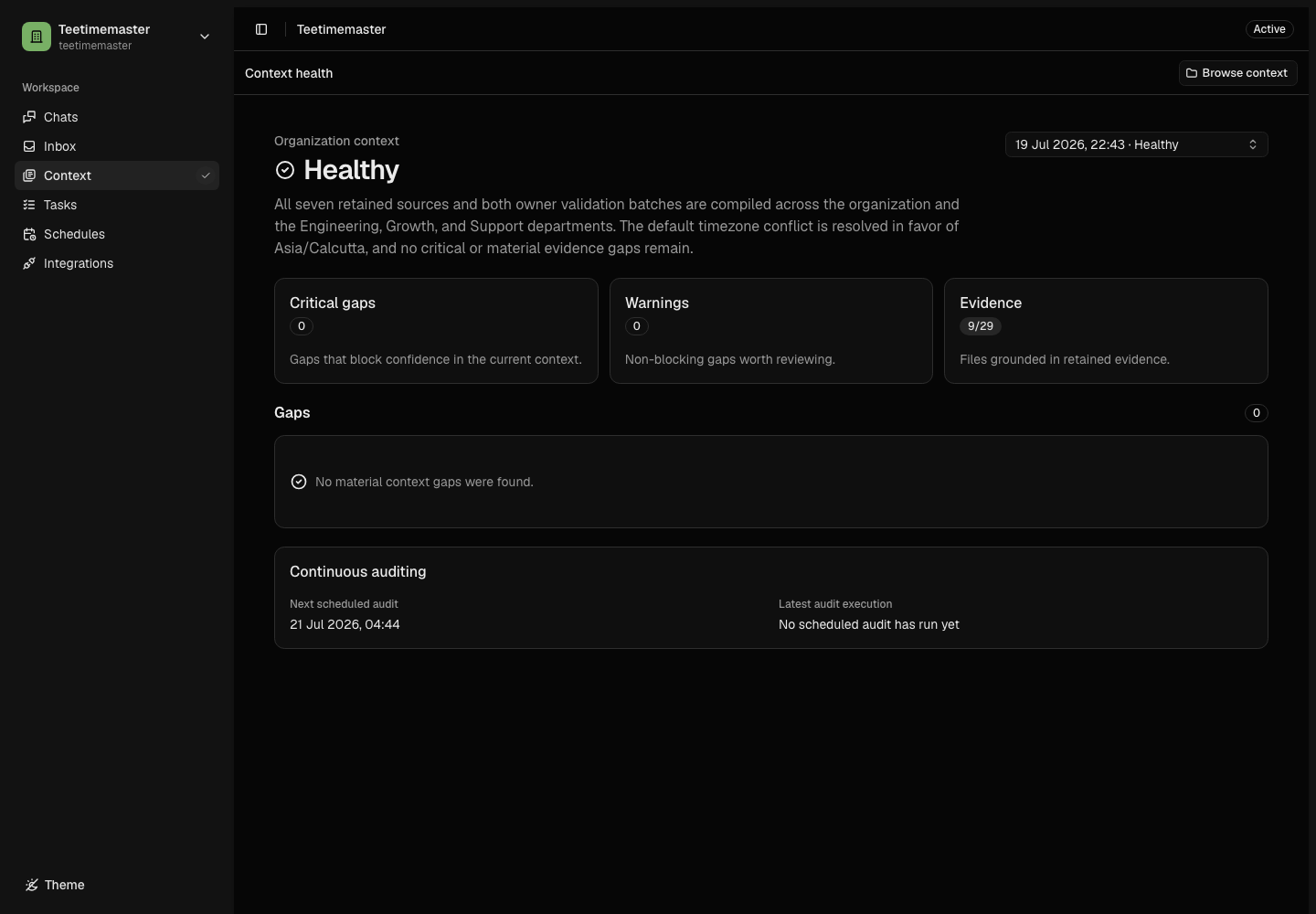
Context health keeps evidence coverage, unresolved gaps, and the next continuous audit visible in one operator view.
Browse Sources
The source browser lets you:
- navigate organization and department files;
- search retained context;
- preview Markdown and text;
- preview PDFs with a text layer;
- download original sources; and
- inspect evidence status and citations.
Evidence Status
- Grounded: the claim is supported by retained evidence.
- Partial: some support exists, but a material detail is inferred or missing.
- None: no retained source currently supports the claim.
When a decision depends on partial or missing evidence, add a source or answer a focused question instead of treating the claim as certain.
Revisions
Context changes create revisions so health and evidence can be compared over time. Historical revisions help explain why an earlier task acted on information that has since changed.
Revision history labels the assessment source as Onboarding, Full audit, or Integration reconciliation. The primary view keeps one aggregate status while preserving separate timestamps for the latest comprehensive assessment and the latest integration-only assessment.
Full Audits and Integration Reconciliation
The fixed full audit runs every 30 hours. It reviews the complete curated Context tree, retained onboarding evidence, and the safe integration registry. An integration reconciliation is narrower: it runs after a material connection, readiness, tool, access-mode, grant, department, identity, or runtime-capability change and reviews only the affected connectors and their relevant facts and workflows.
Integration reconciliation never reads onboarding sources, preferences, lessons, playbooks, or unrelated workflows. It never contacts the provider and never resets the next full-audit time. Presentation-only catalog changes, token refresh, and credential rotation with unchanged readiness do not start a reconciliation.
If a changed connector lacks business meaning, Context Health adds an integration warning and Oblive creates or reuses one focused repair. Human answers may establish declared meaning; the proposed Context files still require approval and backend promotion. Rejection changes nothing. A successful promotion queues one more scoped reconciliation so the warning clears from current evidence.
Reports are fenced against the current health revision, safe-registry revision, authorization epoch, relevant Context hashes, and durable request generation. A stale report cannot replace newer health; the scheduler recovers the latest pending connector set instead.
Keep Context Useful
- Prefer small authoritative files over repeated copies.
- State owners and effective dates for policies.
- Mark planned processes as planned.
- Remove or supersede obsolete guidance deliberately.
- Run scheduled audits and resolve important gaps.
Context versus Task Output
Not every artifact belongs in permanent business context. Promote stable knowledge, verified decisions, and reusable operating rules. Leave one-off drafts, temporary analysis, and hidden model reasoning out of semantic memory.